
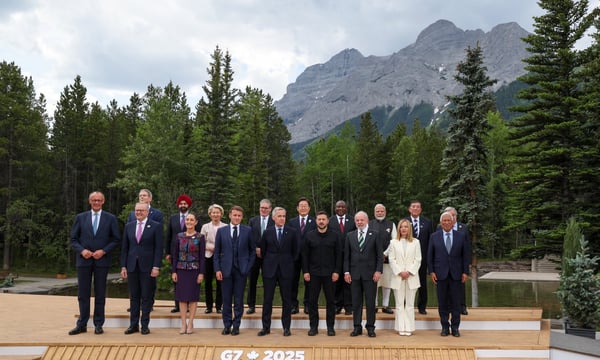
India and the G7: A Relationship That Defies Easy Labels
Every year, as leaders of the world's wealthiest democracies gather under the G7 banner, one country keeps showing up at the table without formally belonging to it: India. This is not a coincidence, nor is it mere diplomatic courtesy. India's recurring invitations to G7 summits speak to something deeper — a fundamental reshaping of the global order and the West's urgent need to reckon with it. Understanding why the G7 keeps calling on New Delhi requires looking at both what India brings to the table and what the G7 is quietly trying to accomplish.
What Is the G7 and Who Belongs to It?
The Group of Seven — comprising the United States, the United Kingdom, Canada, France, Germany, Italy, and Japan, plus the European Union — was established in the 1970s as a forum for the world's leading industrialized economies to coordinate policy on pressing global issues. For decades, membership remained static, a reflection of a post-war economic hierarchy that placed Western nations firmly at the top.
Yet the world has changed dramatically since then. Emerging economies have risen, geopolitical fault lines have shifted, and the challenges facing humanity — from climate change to pandemics to food security — demand cooperation that no seven-nation club can deliver alone. That is where countries like India come in, invited not as permanent members but as what the G7 terms "outreach" or "guest" nations.
India's Growing Economic Weight
The most straightforward reason the G7 keeps inviting India is economic gravity. India is now the world's fifth-largest economy by nominal GDP and, by most purchasing power parity measures, the third-largest. With a population exceeding 1.4 billion people — the largest in the world — and a rapidly expanding middle class, India represents one of the most consequential consumer markets and investment destinations on the planet.
No serious global economic conversation can be had without accounting for India's trajectory. The International Monetary Fund has repeatedly identified India as one of the primary engines of global growth, particularly at a time when China's economy is slowing and Western economies are wrestling with inflation and demographic stagnation. For a forum that prides itself on steering international economic policy, sidelining India would be strategically incoherent.
India as a Geopolitical Swing State
Beyond economics, India holds extraordinary geopolitical value, particularly in a world increasingly defined by the rivalry between the United States and China. India is a democratic nation with deep historical ties to the Global South, a long-standing practitioner of strategic autonomy, and a country that has deliberately refused to align itself completely with any single bloc.
This makes India enormously attractive to the G7, especially as Western nations attempt to build a broader coalition against Russian aggression in Ukraine and to manage the challenge posed by an assertive China. India's voice carries weight in Africa, Southeast Asia, and the Middle East in ways that Western powers often cannot replicate. Securing India's symbolic participation in G7 gatherings is, in part, a way for the West to signal that its preferred world order has broader legitimacy than its membership list might suggest.
At the same time, India has been careful not to be seen as a Western proxy. New Delhi abstained from key United Nations votes condemning Russia's invasion of Ukraine, maintained its energy trade with Moscow, and has consistently championed the interests of developing nations through platforms like the G20, where India held the presidency in 2023. This careful balancing act makes India simultaneously appealing and slightly unpredictable as a partner — which, from New Delhi's perspective, is precisely the point.
New Delhi's Strategic Calculus
India's acceptance of these invitations is not passive. New Delhi has used its G7 appearances with considerable strategic skill, projecting itself as an indispensable voice for the developing world while simultaneously pursuing its own modernization agenda. Prime Minister Narendra Modi has leveraged G7 summits to champion initiatives such as the International Solar Alliance, global digital public infrastructure, and supply chain resilience — positioning India not merely as a recipient of global governance but as a shaper of it.
There is also a prestige dimension that matters domestically. Being seen at the table with the world's most powerful leaders reinforces a narrative of India's rise that resonates strongly with Indian voters and contributes to the broader "Vishwaguru" — or world teacher — framing that has become central to the current government's foreign policy brand.
The G7's Structural Dilemma
The repeated invitation of India also exposes a deeper tension within the G7 itself. The forum's legitimacy depends on its ability to claim some form of global representativeness, yet its formal membership reflects a mid-twentieth-century snapshot of power. Expanding the club formally would dilute its identity and potentially its cohesion. Inviting countries like India as guests offers a pragmatic middle ground — broadening the conversation without restructuring the institution.
Critics argue this arrangement is fundamentally asymmetric: India is asked to contribute ideas and legitimacy without being granted formal decision-making authority. For now, India appears willing to accept this arrangement because the platform itself offers visibility and influence. But as India's power grows, that calculus may shift.
Looking Ahead: Will India Ever Join the G7?
There has been periodic speculation about whether the G7 might eventually expand to formally include India, transforming into a G8 or even a broader democratic alliance. While no such move appears imminent, the frequency and consistency of India's invitations suggests the relationship is deepening well beyond ceremonial gesture.
What is clear is that the G7 needs India more than it once did, and India knows it. The dynamic between New Delhi and the world's richest democracies is one of mutual utility carefully managed — a partnership without full commitment, an alliance without a treaty, and a conversation that neither side can afford to end.
Conclusion
India's recurring presence at G7 summits is a mirror held up to a world in transition. It reflects the G7's recognition that the rules-based international order it champions cannot survive without the buy-in of the countries that will shape the twenty-first century. And it reflects India's own ambition — to be not just a participant in global governance, but one of its architects. In that sense, every invitation is less a courtesy call and more a negotiation about the future of the world.