
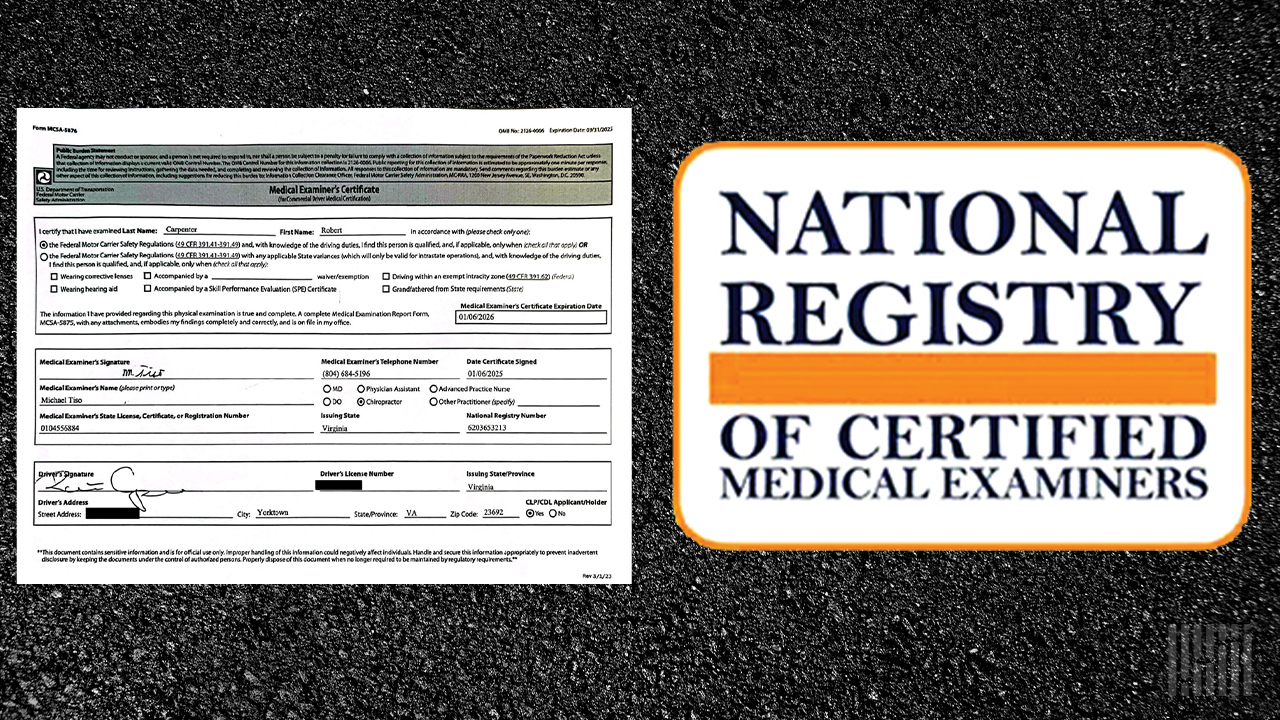
A Silent Threat to Your Commercial Driver's License
Imagine passing your DOT physical with no issues, walking out of the doctor's office with your Medical Examiner's Certificate in hand, and assuming you're fully compliant. Weeks later, you find out your state has no record of your medical certification — and your CDL is on the verge of being downgraded. You did everything right. Your doctor didn't.
This is not a hypothetical scenario. It is happening right now, to real drivers, in states across the country. Industry veterans and first-time CDL holders alike are being blindsided by a systemic compliance gap that sits squarely between certified medical examiners and the FMCSA's National Registry — and most drivers have no idea the risk exists until it's too late.
Two Drivers, Two States, One Systemic Failure
Gord Magill, a well-known and respected voice in the trucking industry, recently went for his DOT physical in New York. The physician completed the exam, issued the Medical Examiner's Certificate without any problems, and Magill left believing everything was in order. Weeks later, he discovered that the physician had never uploaded the results to the FMCSA National Registry system. The state of New York had no record of a valid, current medical certification on file for him.
Around the same time, mill owner Sam Motley had the identical experience with a physician in Virginia. Two different states. Two different doctors. The exact same failure to complete the process.
These are not isolated incidents. Compliance professionals and trucking advocates report receiving dozens of calls each week from drivers facing this same problem. In every case, the driver followed the correct procedure. In every case, the physician failed to complete the final, critical step. And in every case, the driver faced the very real possibility of a CDL downgrade that would pull them off the road — through absolutely no fault of their own.
What Changed With the FMCSA Medical Certification Process
To understand why this is happening, it's important to know how the DOT medical certification process changed in recent years. Under the old system, commercial drivers who completed a DOT physical received their Medical Examiner's Certificate directly from the physician. The driver then took personal responsibility for submitting that certificate to their state driver licensing agency to self-certify. The state would update the driver's Motor Vehicle Record accordingly, and the driver was marked as medically certified.
Under the updated system implemented by FMCSA, that responsibility has shifted significantly. Now, the certified medical examiner — the physician or other qualified healthcare provider who performs the DOT physical — is required to electronically upload the examination results directly to FMCSA's National Registry within 24 hours of completing the physical. The state licensing agency then receives that data automatically. The driver no longer submits anything manually to the state.
On paper, this is a streamlined, modernized system. In practice, it has created a dangerous blind spot for drivers who assume their physician has handled the upload — when in many cases, the physician either doesn't know they're supposed to, or simply fails to do it.
Why So Many Medical Examiners Are Missing the Mark
The core problem is adoption. FMCSA implemented this change, but the medical examiner community has not fully embraced or even understood it. Many certified medical examiners — particularly those who perform DOT physicals only occasionally alongside a general medical practice — are unaware that the upload requirement exists, or they underestimate how critical it is.
This is not entirely unlike what happened when FMCSA launched the Clearinghouse system for drug and alcohol violations. Six years after its introduction, a significant portion of carriers still don't fully understand how Clearinghouse works or that it applies to them. The pattern is consistent: FMCSA introduces a major compliance infrastructure change, and a large segment of the affected professional community lags behind in understanding and implementing it.
The difference with the medical certification upload requirement is that the consequences fall on drivers, not the physicians who drop the ball. A doctor who forgets to upload the results faces limited immediate repercussions. The CDL holder, on the other hand, can face a license downgrade, be removed from service, and lose income — all because of someone else's administrative failure.
How CDL Holders Can Protect Themselves
Given that the burden has shifted to the physician but the consequences still land on the driver, commercial drivers need to take proactive steps to verify their certification status after every DOT physical. Waiting and assuming the process was completed correctly is no longer an acceptable approach.
- Check your Motor Vehicle Record promptly. After completing a DOT physical, request your MVR within a week to confirm that your state's licensing agency has received and recorded your updated medical certification status.
- Verify your entry in the FMCSA National Registry. You can search the National Registry of Certified Medical Examiners to confirm that your examining physician is listed and confirm that your results were submitted.
- Ask your physician directly. Before you leave the exam, ask the medical examiner to confirm that they will upload your results to the National Registry within the required 24-hour window. Get a name and contact information so you can follow up if needed.
- Keep copies of all documentation. Retain your Medical Examiner's Certificate and the long-form physical results as backup documentation in case a dispute arises about your certification status.
- Set a calendar reminder. Give yourself a one-week reminder after any DOT physical to verify your state record has been updated. Don't let weeks pass before discovering a problem.
The Bigger Picture for the Trucking Industry
This issue is a reminder of a recurring challenge in the trucking and commercial transportation industry: regulatory changes that shift compliance responsibilities often create dangerous transition periods where neither the old system nor the new one is functioning reliably. Drivers are the ones who bear the risk during those gaps.
Carriers also have a stake in this problem. A driver pulled off the road due to an unexpected CDL downgrade creates immediate operational disruptions, potential safety gaps, and costly scrambles for qualified replacements. Fleet managers and safety directors should incorporate post-physical MVR verification into their standard compliance workflows, not leave it entirely to individual drivers.
The medical certification gap is real, it is widespread, and it is entirely preventable. Drivers who have done everything right deserve to stay on the road. The solution starts with awareness — knowing that the process has changed, knowing that physicians are not always completing it correctly, and knowing exactly what steps to take to verify your status before a downgrade catches you off guard.
Don't wait for a problem to find you. Check your records, verify your status, and make sure your career isn't at the mercy of an administrative error that was never your mistake to make in the first place.