
What Are Airport Codes and Why Do They Matter?
If you've ever booked a flight and paused for a moment at the three-letter abbreviation next to your departure city, you're not alone. Airport codes — officially known as IATA airport codes — are one of the travel world's most enduring curiosities. Some seem perfectly logical: LAX for Los Angeles, JFK for New York's John F. Kennedy International. Others, like ORD for Chicago O'Hare or MSY for New Orleans, leave even seasoned travelers scratching their heads.
These three-letter codes are used universally across the aviation industry — on boarding passes, luggage tags, flight booking platforms, and airline reservation systems. Understanding where they come from isn't just a fun trivia exercise; it gives you a genuine window into the history of aviation, city naming conventions, and the creative problem-solving that goes into managing a global transport network. Whether you're an aviation enthusiast or just a frequent flyer, learning how airport codes are chosen is surprisingly fascinating.
How Many Airport Codes Actually Exist?
The International Air Transport Association (IATA) is the governing body responsible for assigning three-letter airport codes around the world. As of today, there are over 11,000 airports worldwide that carry an official IATA code assignment. However, that number represents only a fraction of the full picture — there are actually more than 40,000 aviation facilities globally when you factor in private airstrips, military bases, heliports, and smaller regional facilities.
IATA codes are generally reserved for airports that handle commercial passenger traffic. This is a practical decision: with only 17,576 possible combinations of three letters from the English alphabet, the pool of available codes is not infinite. Saving them for commercial airports ensures the system remains functional and sustainable as global aviation continues to expand.
The Best Tool for Decoding Airport Codes
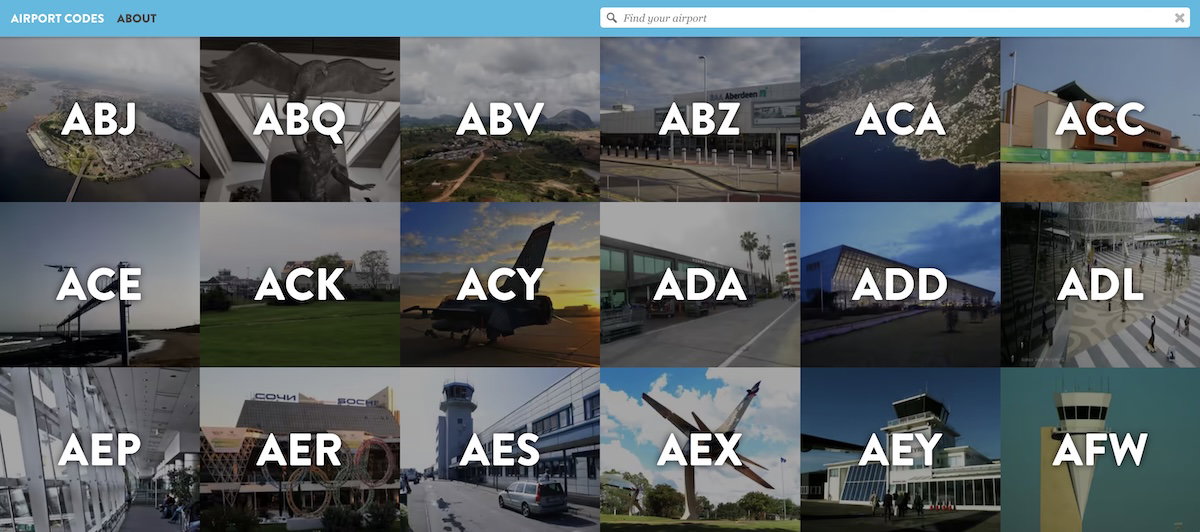
If you've ever wanted to look up exactly how and why a specific airport received its code, there's a wonderfully useful website built precisely for that purpose: airportcod.es. The site lists virtually all major airports in a clean grid format, allowing you to browse or search for any airport by name or code. When you click on a specific airport, you're treated to a plain-language explanation of how that particular code was derived.
For aviation geeks — often affectionately called avgeeks — this site is pure gold. Instead of simply memorizing codes, you get to understand the stories and reasoning behind them. It transforms what might seem like a meaningless string of letters into a meaningful piece of aviation history. Whether you're a casual traveler curious about your home airport or a travel blogger researching a destination, airportcod.es is an invaluable reference tool.
The Most Common Ways Airport Codes Are Chosen
There is no single, universal system governing how airport codes are assigned. The process has evolved organically over decades, shaped by historical context, linguistic differences, city renaming, and simple availability of letter combinations. That said, there are several recurring patterns that explain the majority of codes in use today.
1. Based Directly on the City or Destination Name
The most straightforward approach — and arguably the most common — is naming the code after the city or destination the airport serves. Airports like DEN (Denver International Airport), BOS (Boston Logan International Airport), and MIA (Miami International Airport) all follow this clean, intuitive logic. The first three letters of the city name form the code, making them instantly recognizable to anyone familiar with geography.
This method works beautifully when no other airport has already claimed those three letters. The trouble arises when two cities share similar names or when a city's obvious abbreviation was already taken before the airport opened.
2. Named After the Airport Itself, Not the City
Many airports carry the name of a notable individual, landmark, or institution rather than the city in which they sit. In these cases, the code often reflects the airport's official name rather than its geographic location. The most cited example is JFK, which stands for John F. Kennedy International Airport in New York. Similarly, CDG in Paris refers to Charles de Gaulle Airport, not the city of Paris itself.
This naming approach can create confusion for travelers who expect a city-based abbreviation, but it also serves a practical purpose: cities like New York, London, and Tokyo operate multiple airports, so differentiating them by name rather than location avoids obvious conflicts.
3. Historical and Legacy Codes
Some codes are rooted in history and no longer reflect the current name of the airport or even the city it serves. ORD for Chicago O'Hare is a classic example — it derives from "Orchard Field," the name the site carried before it was renamed in honor of war hero Edward "Butch" O'Hare. The code stuck even as the name changed, a reminder that the aviation industry tends to preserve legacy identifiers rather than disrupt existing systems.
This phenomenon is surprisingly common. Airports that have been renamed, expanded, or repurposed sometimes carry codes that point back to their original identity — a living historical artifact embedded in every boarding pass printed there.
4. Regional or Phonetic Adaptations
In some regions, particularly in countries where the local language uses a different script or spelling convention, airport codes are derived from phonetic transliterations or regional abbreviations that don't map directly onto English spelling. This adds another layer of complexity to an already nuanced system and explains why some codes seem entirely disconnected from any recognizable name.
Why the Inconsistency Is Actually a Feature
At first glance, the lack of a uniform global naming system might seem like a flaw. In reality, it reflects the decentralized, organic growth of aviation itself. Airports were built across different countries, in different eras, under different regulatory bodies — and their codes were assigned accordingly. The result is a rich, layered system that rewards curiosity.
Understanding airport codes is more than a party trick for avgeeks. It's a reminder that even the most technical-seeming systems in modern life carry human stories, historical quirks, and the occasional happy accident. Next time you print a boarding pass, take a second look at those three letters. There's likely a story hiding in plain sight.
Start Exploring Airport Codes Today
Whether you're planning your next trip, satisfying idle curiosity, or feeding a deep love of all things aviation, diving into the world of airport codes is time well spent. Tools like airportcod.es make it easier than ever to explore the stories behind the abbreviations, turning a mundane detail of air travel into a genuinely entertaining rabbit hole. With over 11,000 codes in existence and counting, there's no shortage of surprises waiting to be discovered.