
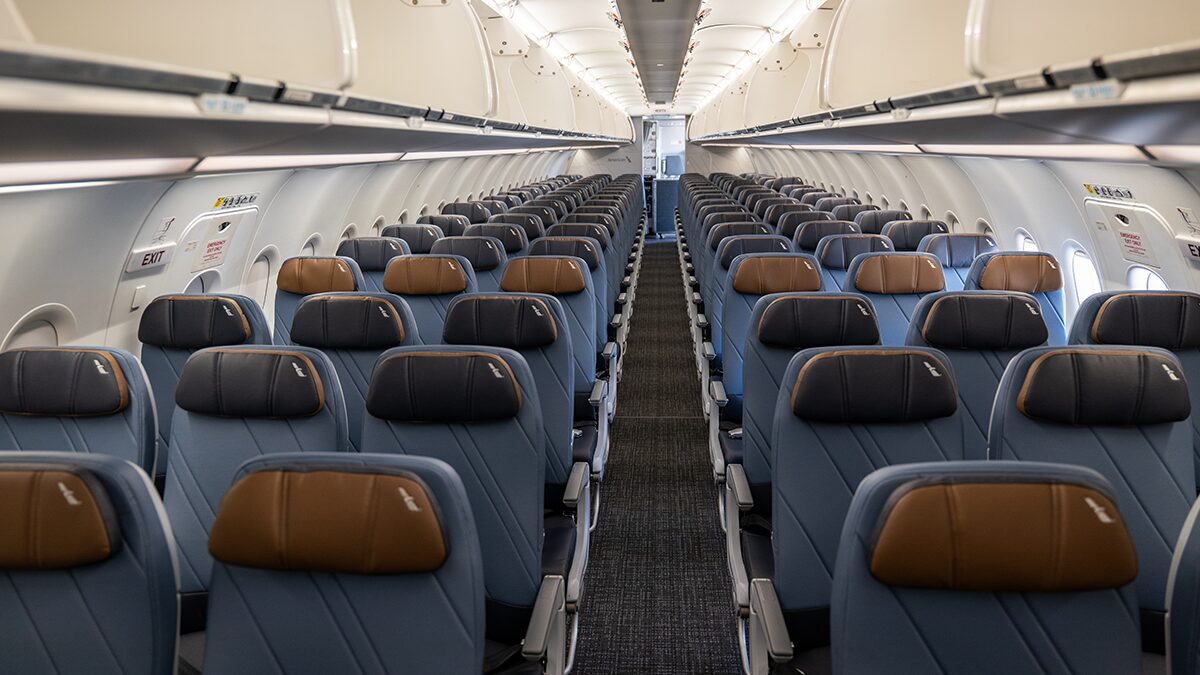
American Airlines' First Retrofitted Airbus A320 Has Officially Entered Service
After months of anticipation and a press release that initially flew under the radar, American Airlines has officially put its first retrofitted Airbus A320 into revenue service. The updated aircraft brings a range of noticeable cabin improvements — expanded First Class seating, larger overhead bins, and a modernized interior aesthetic. But as with many airline cabin decisions, there is a tradeoff tucked into the details: economy passengers are inheriting a slightly tighter environment to make room for the premium expansion up front.
This milestone marks a significant step in American Airlines' broader plan to retrofit its narrowbody Airbus fleet, including both the A319 and A320 variants. For frequent flyers watching the carrier's product strategy closely, the timing and framing of the airline's announcement revealed as much as the announcement itself.
What Exactly Changed Inside the Retrofitted A320?
The retrofitted Airbus A320 cabin has been reconfigured in several meaningful ways. American Airlines has increased the number of First Class seats on the aircraft, giving more passengers access to the airline's premium forward cabin on domestic routes. This expansion is a deliberate commercial decision, reflecting the broader industry trend of leaning into premium revenue as a primary growth engine.
Beyond the seat count, the cabin has received a visual and functional overhaul. The overhead bin situation — long a sore point for travelers on older American Airlines narrowbodies — has been addressed with larger, more modern bins that can accommodate more roller bags in the upright position. Anyone who has wrestled with a carry-on in the cramped overhead spaces on aging A320s will appreciate this particular upgrade.
The interior itself has also received a cosmetic refresh. Cleaner lines, updated materials, and a sharper overall look bring the retrofitted A320 more in line with the newer aircraft American has been adding to its fleet in recent years. It is a meaningful improvement for a cabin that, on older frames, could feel noticeably dated compared to competitors.
The Coach Cabin Tradeoff: More Premium Means Less Space Below
Here is where the story becomes more nuanced for the average traveler. American Airlines has added more First Class seats without removing any coach seats. On paper, that sounds like an expansion rather than a contraction. In practice, fitting more seats into a fixed-length fuselage while preserving the total seat count means that something has to give — and in this case, it is legroom or pitch in the economy cabin.
This is a familiar pattern in the domestic airline industry. Carriers regularly add premium rows to increase revenue per flight, and the geometry of doing so without cutting economy seats typically results in tighter row spacing further back in the aircraft. For passengers booking basic economy or standard coach seats on the retrofitted A320, the experience may feel incrementally more compressed than on the previous cabin configuration.
It is worth noting that American Airlines is not alone in this approach. United Airlines, Delta, and Southwest have all made similar calculations as premium cabin demand has remained robust even as leisure travel has softened in some segments. The economics of a wide, well-populated First Class cabin on a two-to-four-hour domestic flight are simply too compelling to ignore.
Why Did the Press Release Timing Matter?
What made the original American Airlines press release noteworthy — even though it appeared to contain little new information — was the timing of its release relative to the actual entry into service of the first retrofitted aircraft. Airline communications teams often issue or re-surface announcements to coincide with operational milestones, and this case was no different. The renewed attention to the retrofit program was essentially a signal that the rubber had met the runway: the first converted A320 had entered the fleet and was carrying real passengers.
For aviation enthusiasts and airline analysts, reading between the lines of airline press communications is a minor sport. When a carrier issues what looks like a repeat of old news, it usually means something concrete has just happened. In this instance, that something was the commercial debut of a retrofitted aircraft that had been in planning and modification for some time.
What Does This Mean for the Broader American Airlines Fleet Retrofit Program?
The entry into service of the first retrofitted A320 is the starting point, not the finish line. American Airlines has a substantial fleet of A319s and A320s that are expected to cycle through the same retrofit process over the coming months and years. As each aircraft is pulled from service for modification and returned to the schedule, the updated cabin configuration will gradually become the standard passenger experience across these narrowbody types.
For travelers who fly American Airlines regularly on domestic routes, this means the chances of encountering the new cabin layout will increase steadily. Routes operated by A320 equipment — which cover a wide range of short- to medium-haul domestic city pairs — will eventually all feature the expanded First Class product, bigger bins, and the updated interior design.
Should Passengers Be Excited or Cautious?
The honest answer depends entirely on where you are sitting. If you are booking First Class or expect to earn upgrades frequently, the retrofitted A320 is straightforwardly good news. More seats in the premium cabin means more upgrade availability, and the refreshed interior makes the overall experience more pleasant.
If you are a coach traveler, the picture is more mixed. The larger overhead bins are a genuine quality-of-life improvement that will benefit everyone on the aircraft. The potential for slightly reduced pitch in economy, however, is a real consideration — particularly on longer domestic segments where comfort differences become more pronounced over time.
As always with airline product decisions, the details matter. Travelers booking future itineraries on American Airlines A320 equipment would be well served to check seat maps carefully, pay attention to which rows have been affected by the reconfiguration, and make informed decisions about where to position themselves in the cabin.