
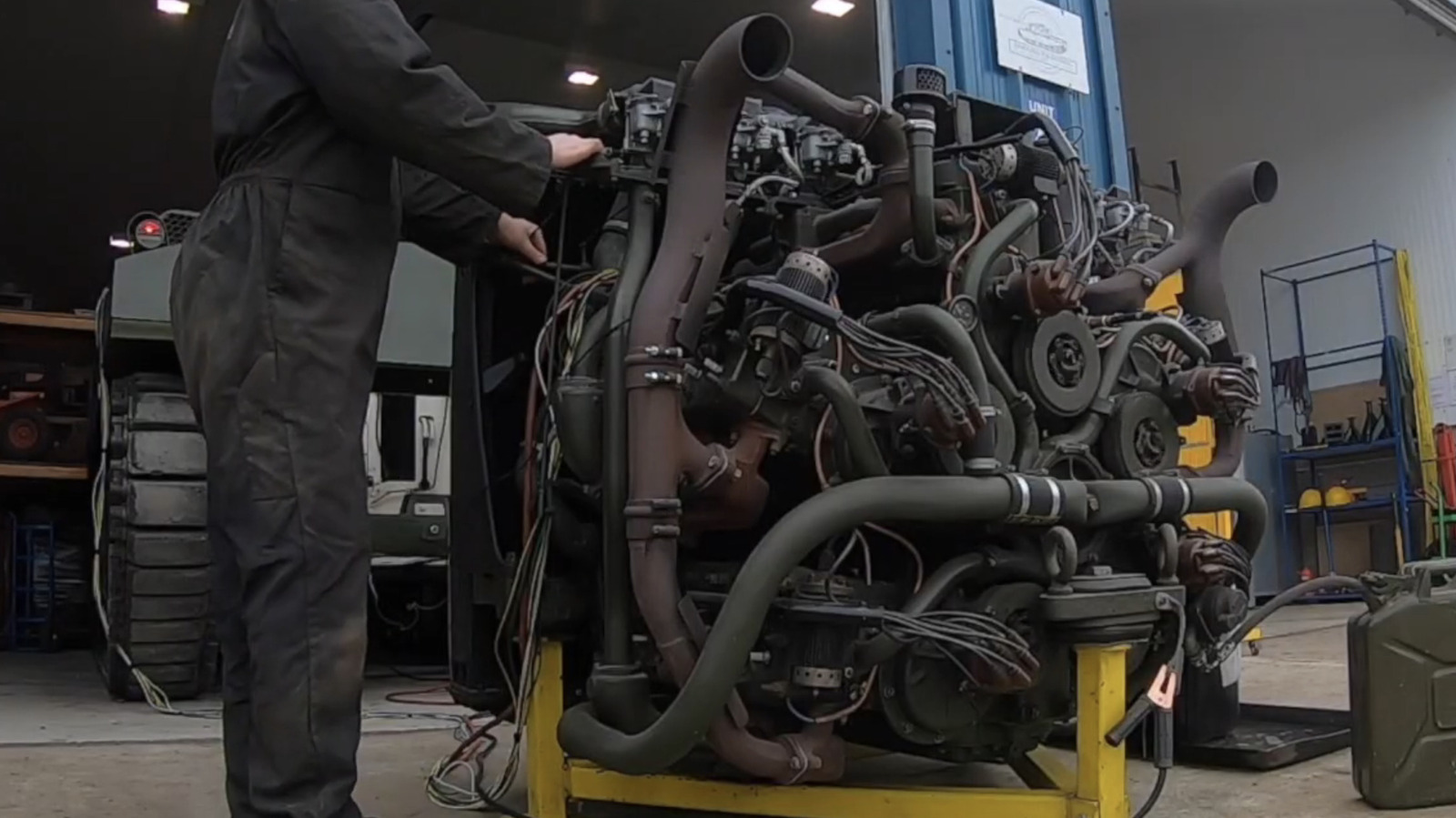
The Most Unusual Engine of World War II: Chrysler's A57 Multibank
When the United States entered World War II, the Allied war machine demanded tanks — and demanded them fast. The M4 Sherman tank became the backbone of Allied armored divisions, but getting enough reliable powerplants to drive thousands of these vehicles was a monumental engineering challenge. Chrysler's answer was one of the most unconventional engines ever produced: the A57 Multibank, a mechanical marvel that essentially bolted five separate inline-six engines together into a single, lumbering powerplant. It was extraordinary, impractical by peacetime standards, and yet it worked.
Why the Allies Needed a Radical Engine Solution
By the early 1940s, the United States Army was scrambling to mass-produce the M4 Sherman tank at a scale never seen before in American manufacturing history. The problem wasn't the tank itself — it was finding enough suitable engines to fill every chassis rolling off the assembly line. A variety of engines were used across different Sherman variants, including radial aircraft engines and twin diesel configurations, but none could be produced in sufficient numbers to satisfy wartime demand on their own.
Chrysler, already a key player in the broader war production effort, was tasked with finding a solution. Rather than designing an entirely new engine from scratch — which would have cost precious months of development time — Chrysler's engineers looked at what they already had and asked a deceptively simple question: what if we used more of it?
Five Into One: How the A57 Multibank Was Built
The A57 Multibank engine was the result of combining five Chrysler inline-six automobile engines onto a single common crankshaft. Each of the five six-cylinder units was derived from standard passenger car engines already in production, which meant Chrysler could ramp up manufacturing quickly without retooling entirely new production lines. The five engines were arranged in a radial-like configuration, each angled outward from the central crankshaft at specific degrees to keep the overall package as compact as possible.
The final assembly produced a 30-cylinder engine displacing approximately 1,253 cubic inches — over 20 liters — and generating around 425 horsepower. For a vehicle as heavy as the Sherman tank, that output was adequate, if not spectacular. What was truly impressive was how quickly Chrysler was able to design, prototype, and produce this engine given the wartime urgency.
Key Specifications of the A57 Multibank
- Configuration: Five inline-six engines on a common crankshaft
- Total cylinders: 30
- Displacement: Approximately 1,253 cubic inches (20.5 liters)
- Output: Approximately 425 horsepower
- Used in: M4A4 Sherman tank variant
- Production period: 1942 through the end of WWII
The Sherman Tank Variant That Ran On the A57
The A57 Multibank was fitted specifically to the M4A4 variant of the Sherman tank. Interestingly, the engine was so long that the M4A4 required a slightly elongated hull compared to other Sherman variants, adding roughly 11 inches to the vehicle's overall length. This made the M4A4 distinguishable from its siblings and also meant that spare parts and maintenance procedures were unique to this model.
Despite these quirks, the M4A4 was produced in substantial numbers. A significant portion of the A57-powered Shermans were supplied to Allied nations through the Lend-Lease program. Britain, in particular, received large quantities of M4A4 tanks, which they designated the Sherman V. The British used these tanks extensively in North Africa and Northwest Europe, and their crews became reasonably adept at maintaining the complicated 30-cylinder powerplant in the field — no small feat.
The Maintenance Nightmare (And Why It Was Accepted Anyway)
No discussion of the A57 Multibank would be complete without acknowledging its well-documented reputation as a maintenance challenge. Servicing a 30-cylinder engine in a forward combat zone was, to put it mildly, complicated. The engine had five of everything — five carburetors, five cooling systems feeding into a unified circuit, and five times the number of potential failure points compared to a conventional single-engine design.
Mechanics had to be familiar with not just one engine, but effectively five simultaneously. Synchronizing the carburetors so that all five units ran smoothly together was an art form in itself. If one of the five inline-sixes developed a fault, it could affect the performance of the entire powerplant. Field repairs were time-consuming, and the engine earned a mixed reputation among the soldiers and mechanics who worked with it.
Yet for all its complexity, the A57 was accepted because the alternative — fewer tanks in the field — was far worse. Wartime logistics often demanded imperfect solutions executed quickly over perfect solutions delivered too late.
How It Compared to Other Sherman Engine Options
The Sherman was unique among WWII tanks for being powered by so many different engine types across its variants. The M4 used a Ford GAA V8, the M4A1 used a radial aircraft engine, the M4A2 used twin GM diesel engines, and the M4A3 returned to the Ford V8. Each had advantages and disadvantages. The A57 Multibank sat at the most complex end of the spectrum but offered the advantage of being built almost entirely from existing, proven components — a critical factor when production speed was paramount.
The Legacy of Chrysler's Multibank Engine
The A57 Multibank engine stands today as a fascinating symbol of wartime American ingenuity. It represents what happens when engineers are handed an impossible deadline, limited resources, and an urgent national need — they improvise. The idea of combining five existing engines into one cohesive powerplant was unconventional to the point of seeming absurd, yet Chrysler made it work, produced thousands of them, and helped keep Allied armor rolling across the battlefields of North Africa and Europe.
Several surviving A57 Multibank engines and M4A4 tanks can still be found in museums around the world, offering modern visitors a chance to appreciate just how strange and remarkable this piece of mechanical history truly was. For anyone with an interest in engineering, automotive history, or the industrial story of World War II, the Chrysler A57 Multibank engine remains one of the most compelling examples of problem-solving under pressure ever assembled.