
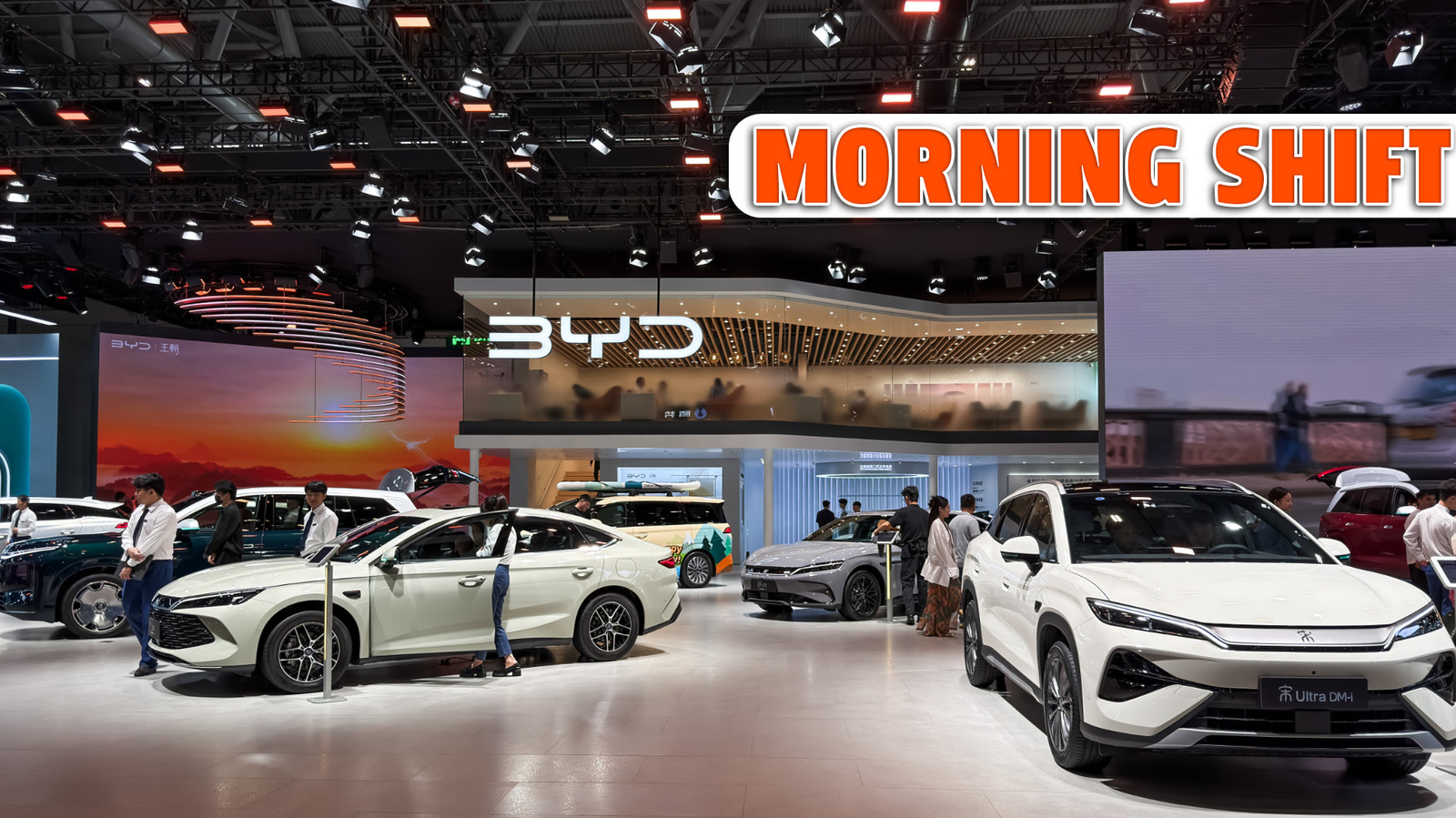
BYD's Audacious Goal: Becoming the World's Number One Carmaker
The global automotive industry is no stranger to bold ambitions, but few declarations have carried as much weight in recent years as BYD's stated goal of becoming the largest carmaker on the planet. The Chinese electric vehicle giant has already overtaken Tesla in total vehicle sales, and now its sights are firmly set on the likes of Toyota, Volkswagen, and every other legacy automaker standing between it and the top of the global leaderboard. If you haven't been paying close attention to BYD's trajectory, now is the time to start — because the company's rise is rewriting the rules of the automotive world in real time.
How BYD Got Here: A Rapid Rise No One Saw Coming
Just a decade ago, BYD — which stands for Build Your Dreams — was largely an afterthought outside of China. Western consumers had little awareness of the brand, and industry analysts were skeptical that a Chinese manufacturer could compete with established giants on the global stage. That skepticism has aged poorly. BYD has since become one of the most vertically integrated automakers on Earth, manufacturing its own batteries, semiconductors, and electric motors, giving it a cost and supply chain advantage that most competitors simply cannot match.
In 2023 and into 2024, BYD posted record-breaking sales figures, selling millions of electrified vehicles — including both fully electric models and plug-in hybrids — across China and increasingly in markets across Europe, Southeast Asia, Latin America, and beyond. Its Seal, Atto 3, Han, and Dolphin models have drawn genuine praise from automotive reviewers for their quality-to-price ratio, further challenging the assumption that affordable EVs must compromise on refinement or technology.
The Competition: Can Anyone Stop BYD?
The big question hanging over the industry is whether any of the established players — Tesla, Toyota, or Volkswagen — can mount a credible defense against BYD's expansion. Tesla remains the cultural benchmark for electric vehicles in the Western market, but BYD's lower price points and relentless product cadence are eating into that advantage. Toyota, the current volume leader in global car sales, continues to lean heavily on hybrid technology and has been slower than many rivals to commit fully to battery-electric vehicles, a strategic bet that may prove costly.
Legacy European automakers are also feeling the heat. Mercedes-Benz, long considered the gold standard of automotive luxury and engineering, is aggressively investing in next-generation electric motor technology in an effort to stay competitive. The company's latest electric motor developments represent a meaningful leap in efficiency and performance, and Mercedes is betting that premium positioning and brand heritage can insulate it from the pricing pressure that BYD brings to the table. Whether that bet pays off remains to be seen, but the urgency behind Mercedes' R&D push speaks volumes about how seriously European brands are taking the Chinese EV threat.
Mercedes' New Electric Motors: A Counterpunch to BYD's Dominance
Mercedes-Benz has been quietly developing in-house electric motor technology designed to deliver greater torque density, improved thermal management, and more efficient energy recovery than many of the systems currently deployed across the EV market. These advances are expected to roll out across Mercedes' expanding EQ lineup and eventually trickle into its broader electrified portfolio. For consumers, this means faster charging times, extended range, and a driving experience that better matches the performance expectations of Mercedes buyers. For the industry, it signals that European automakers are not ready to cede the EV space without a serious fight.
Honda's Recall Woes: A Reminder That Scale Comes With Risk
While BYD advances and Mercedes retrenches, Honda finds itself dealing with a different kind of headline — a significant vehicle recall affecting a large number of its models. Honda's latest recall is a timely reminder that as automakers race to scale production, quality control becomes increasingly difficult to maintain. The specific issue at hand underscores the engineering complexity of modern vehicles, where a single component failure can trigger safety concerns across hundreds of thousands of units.
For Honda, the recall represents both a financial burden and a reputational challenge at a moment when the brand is trying to reposition itself as a credible player in the electrified vehicle space. Honda's partnership with GM on EV development and its own ambitious electrification targets mean that any stumble in quality or reliability carries heightened stakes. Consumers choosing between a legacy automaker's EV and a BYD alternative will be watching closely.
Harley-Davidson vs. Indian Motorcycle: A Sideshow Worth Watching
Not all the automotive drama this week belongs to the EV segment. Harley-Davidson and Indian Motorcycle are engaged in what can only be described as an increasingly petty brand war — a rivalry steeped in history but playing out in a manner that many industry observers have called counterproductive. Rather than focusing collective energy on the broader challenge of attracting younger riders to motorcycling, both brands have allowed their competitive instincts to generate more noise than meaningful innovation. In a market where overall motorcycle ridership is facing demographic headwinds, the spectacle can feel like a distraction from more pressing strategic questions.
What BYD's Rise Means for Consumers and the Industry
For car buyers, BYD's global ambitions are largely good news. Increased competition from a cost-efficient, technology-forward manufacturer tends to drive down prices and push rivals to innovate faster. Markets that have historically had limited access to affordable EVs may find that BYD's expansion opens new options. In Europe, where BYD has been gaining traction despite new import tariffs imposed by the European Union, consumers are increasingly willing to consider the brand on its own merits.
For the industry at large, the message is clear: the era of Western and Japanese automakers setting the pace of the global market is over. BYD's ambition is not a distant threat — it is a present reality that is already reshaping competitive dynamics, pricing strategies, and investment priorities from Detroit to Stuttgart. The race to the top is on, and BYD is running it hard.
- BYD has surpassed Tesla in total electrified vehicle sales and is now targeting overall global volume leadership.
- The company's vertical integration — covering batteries, chips, and motors — gives it a structural cost advantage over rivals.
- Mercedes-Benz is investing heavily in new electric motor technology as a direct response to rising Chinese EV competition.
- Honda's latest large-scale recall highlights the quality control challenges that come with rapid production scaling.
- The Harley-Davidson versus Indian rivalry continues, though many observers question whether the brand war serves either company's long-term interests.
The Bottom Line
BYD's goal of becoming the world's biggest carmaker is no longer the stuff of wishful thinking. It is a strategic roadmap backed by staggering production capacity, relentless product development, and a global expansion push that is gathering speed. For every other automaker on the planet — whether they make luxury sedans in Germany, iconic motorcycles in Milwaukee, or reliable commuters in Japan — BYD's ambition demands a response. The next chapter of the global auto industry will be written largely around how that response takes shape.